By Dr. Elsa Orlandini
She says “yes” to the project her boss offloads on her—even though her plate is already full—and then spends the evening in her apartment, resentment simmering beneath her smile. He texts his ex-partner to check in, again, because the thought of her being upset with him makes his chest tight. They spend hours in relationships, always managing, always adjusting, always working to keep the peace. And they call it kindness.
But something feels off. The joy that should come from giving feels hollow. The approval they chase dissolves the moment they turn away. And there’s a heaviness underneath it all—a quiet desperation that nothing they do ever quite satisfies.
This is the paradox that many people walk into my therapy office with more often than you’d think: people who believe they’re being kind, but who are actually drowning in people-pleasing. And they’re not the same thing at all.
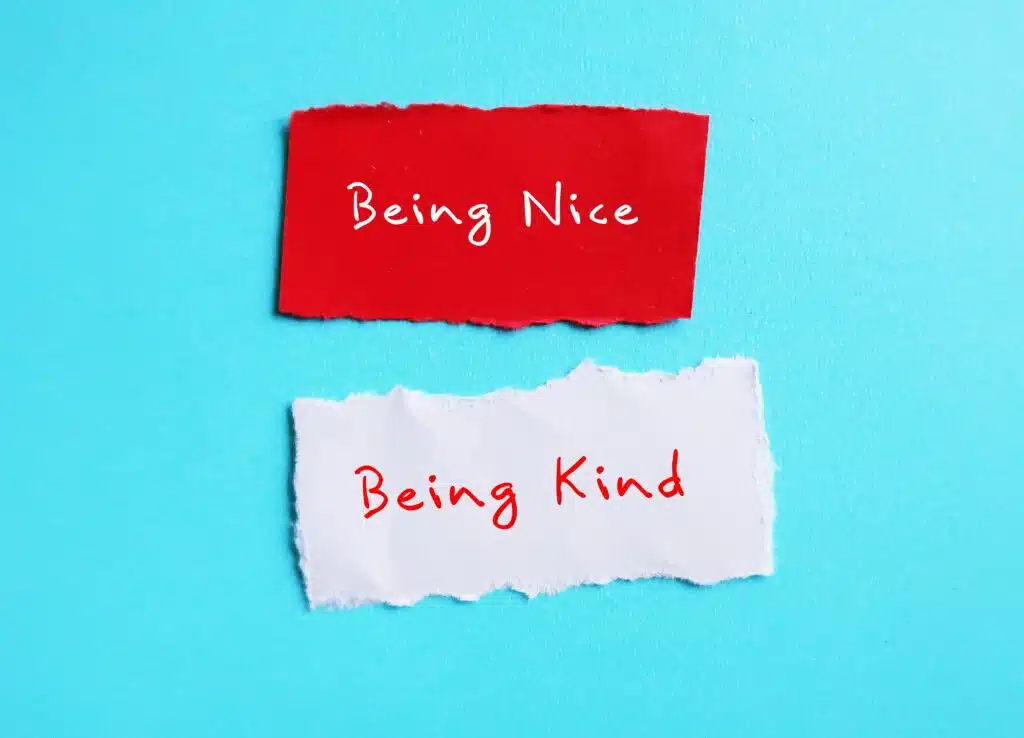
What We’re Actually Looking At: Defining the Terms
Let me be clear: kindness and people-pleasing look similar from the outside. Both involve doing things for others. Both require attention, effort, and a willingness to put another person’s needs into the equation. But the engine running beneath them is entirely different.
Kindness is an act of genuine altruism. It’s giving because you recognize someone’s need and your heart responds. There’s no scoreboard. There’s no condition. You give a gift, offer support, or make a sacrifice because something in you recognizes that this person matters, and their wellbeing has intrinsic value.
People-pleasing, by contrast, is something psychologists call “pathological altruism.” It’s the compulsive tendency to prioritize another person’s perceived needs—or their potential happiness—above your own, often in ways that harm you. And here’s the distinction that matters: people-pleasing is *always* motivated by something else. Fear. The need for approval. The terror of abandonment. A learned belief that your value depends on your usefulness.
When you’re being kind, you’re acting from a place of safety and self-respect. When you’re people-pleasing, you’re acting from a place of scarcity—as if your sense of self hinges on what others think.
The Motivation Test: Following the Thread
The clearest way to tell the difference is to follow the motivation thread. What are you actually hoping will happen?
With genuine kindness, there’s usually an absence of expectation. You do something good, and if it’s appreciated, wonderful. If it’s not, you still feel okay about it because your sense of rightness came from *within you*, not from the response you got.
With people-pleasing, there is always—always—an expectation of return. Acceptance. Recognition. Gratitude. Proof that you’re good, worthy, or lovable. And when that expectation isn’t met, there’s hurt, confusion, or a frantic scramble to do more, try harder, be better.
People-pleasers often don’t realize they’re operating from this place. They’ll tell themselves the story: “I was just being nice.” But underneath that nice was a question: “Will this make them like me?” or “Will they be upset with me if I don’t?” That’s the difference.
Think about a time you did something generous and felt genuinely good about it afterward—not because you got praised, but because it felt aligned with who you are. That was kindness. Now think about a time you did something for someone and immediately felt anxious about whether they appreciated it, or found yourself ruminating about whether you’d done enough. That was people-pleasing.
Where It Comes From: The Roots of People-Pleasing
People-pleasing doesn’t arise in a vacuum. It’s a learned pattern, and almost always, it has roots that run deep into childhood.
Children are naturally dependent on their caregivers for survival and safety. They are exquisitely sensitive to the emotional states of the people around them. And if a child’s environment teaches them that approval is conditional—that love is something you have to earn through good behavior, through compliance, or through managing the emotional temperature of the house—they learn that people-pleasing is survival.
Common environments that breed people-pleasing include:
- Homes where approval was conditional on achievement, obedience, or being “easy”
- Households with conflict or emotional volatility, where a child learned to read the room and adjust themselves to keep the peace
- Emotionally unavailable parents, where a child had to work overtime to get attention or nurturance
- Homes where a child felt responsible for a parent’s wellbeing—whether that parent was struggling with mental health, addiction, or just emotional fragility
- Family systems where emotions were suppressed or deemed “too much,” and quiet compliance was rewarded
These patterns become encoded in your attachment style. Anxiously attached individuals—those who fear abandonment and rejection—often weaponize people-pleasing as a tool to maintain closeness. If I’m useful, if I’m agreeable, if I never cause waves, then maybe you won’t leave.
And here’s the cruel irony: the very behavior that develops to protect us from abandonment often ensures that we feel perpetually unseen, unknown, and disconnected from the very people we’re trying to keep close. Because when you’re always adjusting yourself to be what someone else needs, you’re not being known for who you actually are.
The Cost of the Pattern: What People-Pleasing Actually Does
After years of working with clients who people-please, I’ve seen the consistent toll:
Anxiety and hypervigilance. Your nervous system lives in a state of low-level alarm. You’re always scanning for signs of disapproval, always worried you’ve done something wrong, always bracing for rejection. This constant vigilance exhausts your nervous system and contributes to chronic anxiety.
Depleted self-esteem. There’s a vicious cycle at work: the more you people-please, the more you reinforce the belief that your worth comes from what you do for others, not from who you are. The lower your self-esteem becomes, the more desperate you feel to please, to earn approval, to prove your value. And the more you do this, the lower your self-esteem goes.
Burnout and resentment. You give and give and give, and nothing ever feels like enough. And then, quietly at first, and then louder, comes the resentment. Not necessarily toward the other person—though sometimes that too—but toward yourself. Why did I say yes? Why can’t I just say no? What’s wrong with me?
Disconnection from your own needs. People-pleasers often become strangers to themselves. They don’t know what they actually want because they’ve spent so long focused on what others want. This disconnection from your own authentic desires is profoundly destabilizing.
Attracting unhealthy relationships. People who don’t respect boundaries are drawn to people-pleasers like magnets. You become the person who will rearrange their schedule, absorb their emotions, apologize for things that aren’t your fault, and ask for very little in return. Healthy, boundaried people may find you exhausting precisely because something in the dynamic feels off.
The Crucial Distinction: Kindness Requires Boundaries
Here’s where kindness and people-pleasing truly diverge, and it’s the most important point I want to land:
**True kindness requires that you honor both the other person’s needs AND your own. People-pleasing honors one person’s needs at the expense of the other. And that person being harmed is you.**
Kindness is not a self-sacrificial act. You can be kind *and* have boundaries. In fact, healthy boundaries are a prerequisite for genuine kindness. If you’re constantly self-abandoning to manage someone else’s emotions or meet someone else’s expectations, you’re not being kind—you’re being complicit in your own harm, and you’re enabling others to treat you poorly.
Kindness asks: What does this person need, and what can I genuinely give without harming myself?
People-pleasing asks: What does this person need, and how much of myself can I sacrifice to give it?
These are not the same question.
When you give from a place of genuine kindness, you might be tired afterward, but you feel good. There’s a warm sense of alignment, of having acted in accordance with your values. When you give from people-pleasing, you feel depleted, resentful, unseen, and worried that it still won’t be enough.
How This Shows Up: The Real Patterns
Let me paint some pictures, because this is where the abstraction becomes concrete.
The Relationship Scenario
Person A (kindness): Your partner had a terrible day. You ask if they need support. They say they’d like some space. You respect that. Later, when they’re ready, you listen. You’re warm and present. You also have dinner with a friend you’ve been meaning to see because your own life matters.
Person A (people-pleasing): Your partner had a terrible day. You immediately anticipate what they might need. You drop your plans. You hover, checking in, asking what’s wrong, offering solutions, trying to fix it. You feel anxious if they seem distant. You monitor their mood throughout the evening. You feel hurt if they don’t thank you or if they seem to want to be alone. You lie awake wondering if you did enough.
The Workplace Scenario
Person B (kindness): Your colleague is overwhelmed. You offer to help with one specific task. You set clear boundaries: “I can take this on Thursday morning, but I need it back by 2 PM because I have my own deadline.” You follow through. If they’re grateful, great. If not, you don’t spiral.
Person B (people-pleasing): Your colleague is overwhelmed. You immediately say yes to everything they ask, even though your own workload is heavy. You say yes partly because you want to help, but also because you want them to see you as capable and generous. You hope that maybe the boss will notice. You spend evenings working on their project. You feel resentful when they don’t acknowledge the effort or when they ask for more. You can’t quite bring yourself to say no because the thought of disappointing them makes you anxious.
The Boundary Scenario
Person C (kindness): Your family member frequently criticizes you. You care about them, but you also know that accepting their criticism depletes you. You lovingly set a boundary: “I love you, and I’m not going to accept being spoken to this way anymore. If you want a relationship with me, we need to be respectful with each other.” You follow through. You stay connected if they respect the boundary. You create distance if they don’t.
Person C (people-pleasing): Your family member frequently criticizes you. It hurts, but you accept it because arguing might create conflict, and conflict feels dangerous. You blame yourself for their harsh words. You try to prove them wrong by being better, doing more, achieving more. You secretly hope that if you just become excellent enough, they’ll be proud of you instead of critical. You remain enmeshed in the relationship, unable to create distance, unable to truly protect yourself.
Why This Is Hard: The Emotional Barriers
Here’s what I want to sit with you about: if people-pleasing is so painful, why do people keep doing it?
The answer is both simple and profound: because at some point, it worked.
People-pleasing developed as an adaptation, a survival strategy. If you grew up in an environment where your safety, your belonging, or your access to love felt contingent on your behavior, people-pleasing made sense. It was intelligent. It was how you protected yourself.
But here’s the problem: the part of you that learned this strategy is still running the show as an adult. Your nervous system learned early: “If I anticipate needs, if I’m agreeable, if I don’t rock the boat, I’m safe. I’m loved. I belong.” So even as an adult, even in relationships with people who would love you regardless, even in situations where you have every right to say no, that old protective mechanism kicks in.
And here’s another piece: shame. Most people-pleasers carry deep shame about who they are underneath the compliance. They fear that if they stop managing others’ emotions and start having needs of their own, they’ll be seen as selfish, demanding, unlovable. The thought of being honest about what they want feels dangerous, even when, objectively, there’s no danger.
This is why understanding the roots matters. You didn’t become a people-pleaser because you’re broken or fundamentally flawed. You became one because you were adapting to an environment. The behavior that once protected you now costs you. And that’s what therapy can help you see and change.
People-Pleasing in Miami: When Culture and Pressure Collide
Miami is beautiful, dynamic, and deeply social — and for many people who struggle with people-pleasing, it’s also an intensely activating environment.
Whether you’re navigating the high-stakes atmosphere of Brickell’s finance corridors, the image-conscious social scenes of South Beach, or the deeply held cultural expectations within Miami’s Latino, Caribbean, and immigrant communities, the pressure to be agreeable, pleasing, and “on” is omnipresent.
In my clinical work with Miami and Miami Beach clients, people-pleasing is one of the most common presenting concerns. It tends to cluster around a few recurring dynamics:
The professional achiever. Miami’s competitive business culture rewards people who are adaptable, accommodating, and eager to deliver. Over time, this bleeds into identity. High-achieving professionals learn to suppress their own needs — not out of passion, but out of a fear of seeming difficult, demanding, or “not a team player.” The please-everyone habit that gets you promoted can quietly hollow you out.
The family-loyalty bind. Many of Miami’s tightly-knit cultural communities carry beautiful traditions of collectivism — family first, community before self. But for individuals who already carry anxiety around belonging, these norms can calcify into self-erasure. “I can’t disappoint my family” becomes the sentence that overrides every authentic impulse.
The social performance. Miami’s social culture — curated events, social media image, the relentless performance of success — creates constant opportunities for comparison and approval-seeking. People-pleasers in Miami often find themselves performing constantly: the right look, the right response, the right mood. The exhaustion is profound, and it rarely has anywhere to go.
The good news? Awareness is the first intervention. And if any of this resonates with you, working with a therapist who understands both the psychology and the cultural landscape of Miami can make a significant difference.
Checklist: Is This Kindness or People-Pleasing?
Use this reflection tool to get curious about your own patterns. Notice which statements resonate with you. This isn’t a diagnostic—it’s an invitation to self-awareness.
This is likely healthy kindness if:
- ☐ I gave freely without expecting gratitude or reciprocation
- ☐ Afterward, I felt good and energized (or peacefully tired), not anxious or resentful
- ☐ I respected my own needs and didn’t sacrifice something important to me
- ☐ I had the choice to say no, and I said yes because I genuinely wanted to
- ☐ The person could have responded with indifference, and I would still feel okay about my choice
- ☐ I’m not keeping a mental scoreboard of what I’ve done for them
- ☐ I feel seen and known in this relationship, and they see and know me in return
- ☐ My giving is aligned with my values, not driven by fear or shame
This may be people-pleasing if:
- ☐ I said yes when I wanted to say no, but I feared their disappointment or anger
- ☐ Afterward, I felt empty, resentful, or anxious about whether I’d done enough
- ☐ I’m monitoring their mood or reaction closely, waiting for approval or reassurance
- ☐ I offered more than I could actually give without harming my own wellbeing
- ☐ I’m hoping this gesture will make them like me, love me, or finally see my worth
- ☐ I’m keeping track of what I’ve done and feel unappreciated
- ☐ I don’t feel truly known in this relationship; I’m always adjusting who I am
- ☐ My giving is driven by anxiety, shame, or a fear of being left or rejected
Frequently Asked Questions
Q: Can someone with people-pleasing tendencies ever be genuinely kind?
A: Absolutely. Recognizing the pattern is the first step. Once you become aware of your people-pleasing habits, you can start making conscious choices about when and how you give. Over time, with therapeutic work—especially approaches like CBT, ACT, or psychodynamic therapy—you can learn to act from a place of genuine kindness rather than compulsion. It’s a process, not an on-off switch.
Q: Is it selfish to set boundaries and say no?
A: No. This is perhaps the most important reframe in therapy for people-pleasers. Healthy boundaries aren’t selfish; they’re self-respecting. And here’s what’s counterintuitive: people who respect themselves and maintain boundaries are actually *better* friends, partners, and colleagues. Why? Because they’re not secretly resentful. They’re not overextended. They’re not doing things out of fear or obligation. When they say yes, it means something.
Q: I grew up in a family where people-pleasing was the norm. Can I really change?
A: Yes, though it takes intention and usually professional support. Your attachment style and learned patterns aren’t destiny—they’re adaptations that you can become aware of and gradually rewire. Therapy works. With consistent support, you can develop what’s called “earned secure attachment,” where you learn to be safe with yourself and others in a different way.
Q: What’s the difference between people-pleasing and codependency?
A: All codependent people are people-pleasers, but not all people-pleasers are codependent. People-pleasing is the need or desire to make others happy at the expense of your own needs. Codependency is the need to feel needed, and it often involves taking responsibility for managing another person’s emotions or wellbeing in an unhealthy way. Codependency is a deeper and more complex pattern that usually benefits from longer-term therapy.
Q: If I stop people-pleasing, won’t I lose people?
A: Some relationships may shift or even end when you start setting boundaries and being more authentic. And yes, that can be painful and scary. But here’s the truth: the relationships that end when you stop abandoning yourself were relationships built on your self-abandonment. They weren’t based on you being known and loved for who you actually are. The relationships that survive and deepen are the ones that can accommodate a fuller, more boundaried version of you. Those are the relationships worth keeping.
Q: How do I start changing this pattern?
A: Start by noticing. Notice when you’re saying yes and feel a flash of panic or dread. Notice when you’re monitoring someone else’s reaction to see if you’ve been “good enough.” Notice the resentment. These moments of awareness are where change begins. And then, consider therapy. Therapeutic approaches like Cognitive Behavioral Therapy, Dialectical Behavior Therapy, and Acceptance and Commitment Therapy have all shown strong results in helping people break free from people-pleasing patterns. You don’t have to do this alone.
The Kindness You Actually Deserve: Finding Your Way Home
If you recognize yourself in the people-pleasing pattern, you’re not broken. You’re not fundamentally flawed. You’re someone whose nervous system learned early to prioritize connection and safety above all else. That capacity for attunement, for sensing what others need, for caring deeply—these are gifts. They’re not the problem.
The problem is that these gifts have been conscripted into a service of fear instead of love. And that has to change.
True kindness—the kind that fills you up instead of emptying you out—is possible. But it requires you to turn that attunement inward for a moment. To ask yourself: What do *I* need? What do I want? Who am I when I’m not performing for anyone else? These questions might feel selfish or scary. They’re not. They’re the path home to yourself.
And when you find your way home to yourself, when you learn that your worth isn’t contingent on what you do for others, something shifts. You become capable of genuine kindness—the kind that flows from fullness rather than desperation, from security rather than fear. You become capable of true connection in your relationships, authentic individual growth, and the kind of peace that comes from living in alignment with your own values.
That’s the relationship you deserve. That’s the life you deserve.
Ready to Do the Work? We’re Here.
Miami Psychology Group offers compassionate, evidence-based therapy for individuals, couples, and families.
Meet our team of experienced psychologists and therapists
Our team is available:
- In Person: Miami Beach, FL | Miami, FL
- Virtually: Telehealth sessions available throughout Florida
Our Services include:
- Individual Therapy & Psychotherapy
- Couples Therapy & Relationship Counseling
- Relationship Therapy
- Family Therapy
- Anxiety & Panic Attacks
- Depression Treatment
Take the First Step
Schedule a Consultation | Contact Us
We offer in-person sessions in Miami Beach, FL, as well as secure virtual sessions for clients throughout Florida.
Sources & Further Reading
- The Difference Between People-Pleasing and Being Kind — Psychology Today
- What is Codependency? Traits and Characteristics — PsychCentral
- People-Pleasing and Pathological Altruism — Psychology Today
- Attachment and Adult Relationships — HelpGuide
Dr. Elsa Orlandini is a licensed psychologist and the founder of Miami Psychology Group. Her work focuses on relational health, attachment, and the intersection of emotional intelligence and mental wellness. Contact us to schedule a consultation.